

It is a sobering fact to realize that, when Hemingway was my age, he’d been dead for 14 years.
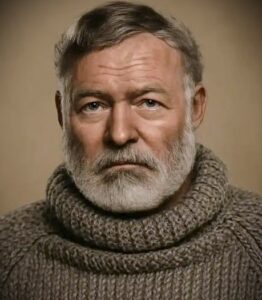
Back in the day, this writing demigod was steadily lionized as the absolute acme of vitality and virility. Turns out, though, all that multi-sourced hagiography amounted to a heap of hooey—every bit as fictional as one of the big guy’s own books.
The basics are: Hemingway was a sexually confused, rampantly alcoholic, paranoid, serial adulterer and exploiter of his spouses who sought refuge in a hyperbolic masculinity. But that lush carapace of woven chest-hair bore scant resemblance to the highly disturbed individual who burrowed, cowered, and hid himself within it.
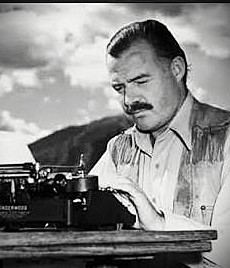
Apart from his role-playing, the gent happened to be a rather talented literary stylist who ushered in a whole new era in writing. He honed—and reestablished—the power of a simple declarative sentence. He managed to accurately sketch the cynical and wounded male psyches of the Western world, as guys sought to pump themselves up and further their pursuit of happiness in a complex era bracketed by the bloody debacles of two world wars.
A horde of men, especially the youngest Baby Boomers born in the mid-20th Century, tended to model themselves on Hemingway—or, more accurately, upon overblown myths the culture spread about him.
And among their number, you’d need to include me.
EXIT STRATEGEMS
Afterglow of his mythology gets particularly problematic, though, at a point when you sail past the crest of mid-life and begin to try to conjure a way to navigate your approaching downslope.
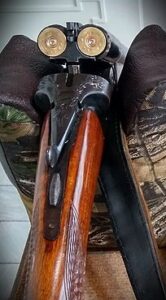
Hemingway’s solution to challenges of his own precipitant decrepitude was famously messy. His eternal fascination with potent firearms lurched to a quite sad finale. On his ultimate African safari, his rifle was snatched away from him by the guides, lest he endanger others in the party via his faltering marksmanship. The man didn’t miss with his last shot, though. But that was because he had both barrels of a 12-gauge shotgun pressed firmly against his forehead.
‘Tis a consummation devoutly to be unwished. Especially by any of one’s dear companions who might find themselves forced to clean up a scene like this in its aftermath.
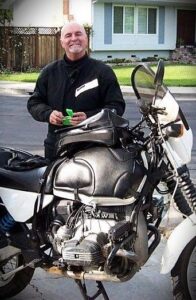
Aspects of my own life might seem a decent match for the Hemingway-esque, macho credo. I’ve long been an outdoorsman and fitness buff, even made a career of it by selling tons of stories on such themes. I’ve hunted and fished, and engaged in plenty of risk sports, including (but not limited to) surfing, ski mountaineering, rock-climbing, motorcycling, sky-diving, whitewater kayaking, marathoning, scuba, mountain biking, and… Oh yeah, underwater hockey.
I’ve even boxed. Well, barely enough to grasp how to deliver a few types of punches and block others. Did it for a while, until several attempts to fall asleep while fending off an awful headache (due to concussion) convinced me that pursuit of optional combat was (literally) a mug’s game.
Now, as I ricochet on through a mounting collection of decades, I find this body I’ve relied upon to convey me smoothly through hazardous pastimes—while extracting me from related mishaps—begins to refuse to rise to every occasion. Takes much longer to repair an injury, too.
“And you know that you’re over the hill when your mind makes a promise that your body can’t fill.” – Little Feat.
THE ORGAN RECITAL
The subhead above derives from the coffee-klatches at my grandma’s house. These tended to include my mother, her sister Connie, and whatever other friends and relatives happened to be in the ‘hood. These took place around 10 AM, after the husbands obligingly got their butts out of the way by toddling off to work.

Now, Connie was a real pip, with a gift for the well-phrased complaint. She lived to be 104, but when she was about half that old, she coined “organ recital” for that portion of a morning meet-up when all the assembled ladies began to recount their various health issues. “After a certain age,” she’d remind them, “it’s just patch, patch, patch!”
Of late, that’s a motto I must increasingly deploy. Some parts of the strategy demand ongoing repair; others, triage applied to my menu of preferred activity; and beyond that, greater avoidance of harmful habits. If this doesn’t sound like fun, I assure you, it’s not. Wait, wait! No, I mean, maybe one ought to redefine “fun.”
Or as another doyen of the 20th Century literature—William Saroyan—once put it: “I’m falling apart! And it’s very interesting.”
THE ART OF PATCHWORK QUILTING
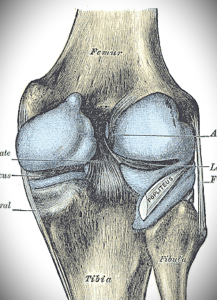
About six years ago, I had my knees X-rayed to determine, among other things, if I ought to further my love of trail running. The pro med verdict: Your knees are in fantastic shape for an ol’ boy! No visible signs of wear or damage! And so, yay. I proceeded to double-up on both my runs and my weight-bearing exercises.
Then, about six weeks ago, after a bout of pain and stiffness in the right knee, I got them X-rayed again. Verdict: The meniscus pads in both knees are now worn away by about a third, dude, and you’ve got a drooping patella in the right one. Ouch. Among other results, this indicated that my body’s ability to repair itself had entered decline. And/or, it proved that doubling down on my usual fitness regimen was exactly the wrong strategy.
The burst of depressive enlightenment led to a reassessment of my entire lifestyle.
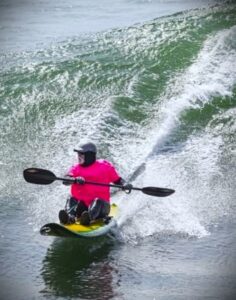
Now, I’m no stranger to dropping an activity once I’ve nailed a major goal for it. For example, I quit whitewater kayaking at age 50, after I’d paddled 270 miles of the Grand Canyon. I left motorcycle riding behind in my 60s, because I’d walked (or hobbled) away from a pair of “totals,” and didn’t wish to tempt fate by trying another. My climbing climaxed with a 5.10 ascent in Yosemite. Since I’d nearly puked and pissed myself at the crux, I dubbed this route my personal best, then gave away my chalk bag.
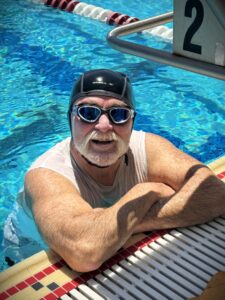
Now, I see I must gradually replace trail runs with more biking and swimming workouts. I’ll also have to supplant my ardent downhill skiing with much more cross-country, shun all major weightlifting for sessions of milder weight-swinging (with my tail plopped on a bench), and so on and so forth.

Speaking of dropping weights, I’ll need to shed avoirdupois off of this poor ol’ bod’ itself, too. I’ve long had a goal of paring myself down to my college heft, of some 210-215 pounds. At this point, such a goal looks mandatory. I plan to achieve it in the old-fashioned way: liposuction! And I intend to achieve the “lipo” via an old-fashioned form of it, too; I’ll simply add calorie reduction to my aerobic exercise sessions.
Adopting measures like these might be my sole hope for keeping a degree of true pep in my step. For a period, anyway. Certainly, not forever. Eternal youth shall never be granted unto us, despite any whims we might nurse in the matter.
QUEST FOR AN UNSACRAL GRAIL
I find it completely hilarious that tech execs—self-styled masters of our universe, already choking on more dough than they could hope to spend in a lifetime—now ardently seek to garner more time on Earth. This, presumably, so they can achieve ever more voracious bouts of consumption.
Or perhaps I do them an injustice here, and what they’re truly after is only a few more chances to shower a grateful nation with dribbles of their alluring charisma.
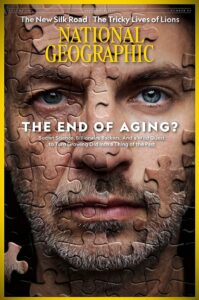
This trend has grown so, well, trendy, that National Geographic devoted a lead story in its most recent issue to it. On the mag’s cover: “The End of Aging? Secret Science, Billionaire Backers. And a Wild Quest to Turn Growing Old into a Thing of the Past.”
Kudos to the copy editor who came up with those lines, BTW. Even though the mag’s editor-in-chief probably blew a spray of coffee out of his nostrils when he first read them.

I also hope these digital, latter-day Ponce-de-Leons don’t wreck their actual lifespans by consuming too many microdoses of this ‘n’ that, overdoses of some other stuff, or off-label use of hormones, peptides, placebos, hallucinogens and various snake oils. It’s always exciting to gamble, yes, but coming up snake-eyes shall forever remain a major option as you do it.
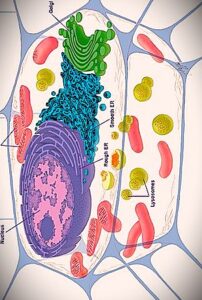
And a basic truth to consider is, these guys can’t pose as masters of the universe, since no one gets to be any such thing. However, they are genuine lords of galaxies! In fact, each inhabitant of any human body gets to be a lord, and each of our galaxies is composed of 27 trillion cells, all of them lil’ critters holding hands (so to speak), while avidly interacting to create a temporary chance for you to be you. To score your best (and longest) life, just seek to provide them with all the stuff they need, and they’ll endeavor to respond in kind.
What these cells require is no giant secret that demands expensive and painstaking research projects conducted by overpaid microbiologists in dedicated labs. Our bodies basically need, want, and respond to: clean, fresh water; clean fresh air; basic, unpolluted, fresh nutrients; and enough steady circulation (read, exercise) to move all that stuff around to places in our bodies where it’s needed, while shipping waste products out that have turned useless or detrimental.
That paragraph above is the true formula of “blue zones” where humans tend to lead long and relatively healthy lives—a keynote of which is that even the aged folks in such places do a dose of actual physical labor on a daily basis. And right there’s your magical elixir, if you’re on the hunt for one.
PALEO PALES NEXT TO MENTAL MODULATION
Now, I don’t aim to come across like some kind of Luddite, here. If said bio scientists discover new meds that actually cure problems w/o also incurring deleterious side-effects (Ozempic? Dude, I’m lookin’ at you!), all well and good.
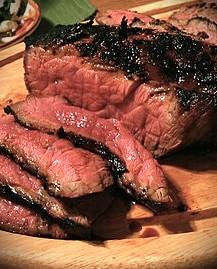
I also heartily approve of some trends, like the movement away from highly-processed foods toward much simpler nutrients far lower on the food chain. I don’t think one need go rapidly or rabidly Paleo to benefit from this shift, and plunge all the way back into gobbling gobs of rare meat, chased by fistfuls of raw veggies.
Whole grains, nuts, berries, leafy greens, colorful and fibrous fruits will get you where you need to go, and consuming modest portions of meat or fish equate to what’s sufficient for our health as well as best for our planet.

And please bear in mind, there’s a reason why cooking was developed millennia ago in almost every human society (except for those spots where dumbos somehow managed to fumble the formula for fire). And that reason is: cooking helps break down food to aid in digestion, while also subtracting nasty parasites and perilous pathogens from your diet.
Health also relies on mental components. Sources of high stress—like attempting to live forever, or striving to preserve for all time a self that the universe has plainly designed to be temporary—will complicate your life, but not necessarily prolong it. I mean, in a good way.
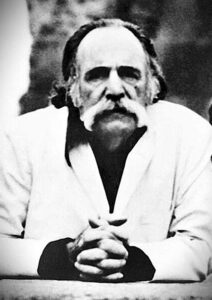
Here’s William Saroyan again. “I know everybody has to die, but I always rather thought an exception might be made in my case.” SO tongue-in-cheek, Billy-boy, and yet right on the money!
Embrace of the inevitable is a fine way to trowel the path ahead.
DO-SI-DO WITH BARDS OF THE BARDO
And so, I embark upon my new policy that aims to slim down and slow down, yet keep moving. I’ll seek ways to work all muscles whilst still sparing my joints.
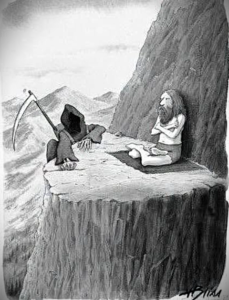
Can’t complain. Well, actually, I could, yet why? For my age, I’m in pretty good shape—particularly, when compared to a certain bulbous and flatulent president who’s only four years older than I.
I recall, when I was a tad (tadpole, actually) and just beginning to swim and dive at a public pool in Florida, I learned the basics of bouncing and hurling myself off a board. Mastering a simple forward dive was the move that came first, of course. I saw that pointed hands, a strict vertical line and pointed toes, combined to create the smallest possible splash on entry, produced the performance desired.

And even way back then, I spotted a larger lesson—this was also a correct way to die. When the time comes for us to give back to the universe this precious gift of a human incarnation, let us do it gratefully, gracefully, and with an open heart and hand. Pierce the membrane of the beyond with a smooth and confident technique, while making the smallest possible disturbance.
Allow concentric ripples of your passage to spread and vanish. Let those briefly troubled waters heal themselves behind you. Glide on, ever deeper into your cosmic destiny.