

Carpentry has been defined as the art of making small pieces of wood out of big ones.
I tucked this wisecrack into my toolbox years back, whilst becoming a journeyman union carpenter. Of course, a related axiom, “Measure twice, cut once,” suggests some level of skill should also wind up in your vicinity.
See, demands of this craft are more intricate and intriguing than they might appear to the uninitiated.

I’ll also say that an ability to heap up sawdust has proven my boon companion through many an ensuing decade. First, it became a revenue-generating asset in my freelance writing period. Next, it generated value, security and comfort in every place I’ve dwelt. And it still awards me a route to go mano-a-mano with physical matter—to my ultimate benefit in many ways.
Writing, by comparison, demonstrates a clear downside: its highly ephemeral nature. One might pour immense doses of devotion and time, a veritable tsunami of blood, sweat and tears, into crafting a piece of writing, only to see it flounder briefly before vanishing into a desk drawer like a bashful ghost. After which it proceeds to grant a nil return on all that investment.

Sadly, your shining seed seems to have spilt onto stony ground. (Onan would sympathize.) In compare, Schrodinger’s Pussycat demonstrates a super-charged existence. At minimum, that fabled feline enjoys a 50% chance of someday emerging to bat a Ming vase off your shelf and scatter its ragged shards before astonished onlookers.
However! Should I grab my carpentry tools and construct an actual door, then I soon can swing the thing open to walk through. It’s a 100% probability. Build a table, and I can sit there and dine; even construct a house and be able to sell it for some decent coin. And yes, I’ve enjoyed the fruits of many such projects. That kind of effort builds a tangible result, one to use and savor. Plenty of mental and physical benefits accrue from hands-on work, too.
That’s why—as twin trends of ascendant AI and industrial robotics threaten nearly every form of modern employment—I urge youngsters to move away from the fraught digital fray for a nice, long respite. Take a sabbatical to acquire an old-school trade for yourself. Carpentry, plumbing, welding, electrical work, farming, ranching, well-drilling, solar installation, etc. Then, whatever whimsy happens to traipse onto our turf next, you’ll always own a highly portable method of earning a wad of cash while accomplishing something useful.
MEANINGFUL MEDIA MENTIONS
I’m not the only guy who recommends this. A spate of Wall Street Journal articles recently explored the growing number of nerds, geeks and white-collar wage-slaves who found themselves wishing to re-think the worth of some different, supposedly low-brow pursuits.

“‘Learn a trade,’ isn’t just a rallying cry for younger generations to skip college and pursue-in-demand blue collar work. For burned-out white-collar workers, it has become a popular midcareer fantasy.” That’s an excerpt from a WSJ piece, by Allison Pohle and Te-Ping Chen.
Here’s another, by Callum Borchers. “Could your pride handle work in construction, security, or at an auto-body shop? The best way to get over your midcareer slump might be to get over yourself, first. Layoffs and stagnant wages have a lot of white-collar workers feeling stuck… Meanwhile, blue-collar industries face a labor shortage.”
According to a WSJ editorial, Florida residents who lack citizenship papers recently constituted half of all farm hands in that state, and a full third of construction workers. Meanwhile, for every five departing the building trades, just a single applicant entered that field.

Let’s save discussion of whether heedless, wholesale deportation policies compound this problem. But, meantime? The crisis shall spawn opportunity. The New York Times seconded this motion in May with a story by Emily Lang. “Citing poor job prospects, the costs of college and fears that AI may soon take over their jobs, dozens of hopeful and current apprentices said that a job in the trades seemed like the best route for their futures.”
Worry nary a jot about getting your hands dirty, son; that’s why God (in the form of the William Waltke firm a century ago) invented Lava Soap.
SWEEP OF THE DIGITAL SCYTHE
Are you able to see from the above that I remain a fan of news in print? Indeed, I have been, since my time as a toddler. And at our manse we yet subscribe to three actual newspapers. We strive to prop up traditional newsrooms, and that’s a good way to contribute to the reportorial ecosystem.

(Have you heard this bit? “Without journalism, there’s no democracy?” To which I’d respond, “Tru, dat…”)
A few days ago, an op-ed by a San Francisco high school teacher, John Lisovky, ran in that city’s Chronicle. To wit: “Over the past 15 years, I’ve watched childhood and adolescence shrivel into a joyless, screen-addicted malaise because Big Tech decided that sucking the lives of kids through their eyeballs is great for business. Test scores are in a generational decline. Sleep deprivation is rampant. College students can’t read books.”
Here’s another, by Maddie Freeman, also in the Chron. “ChatGPT launched during my junior year of college, quickly becoming the fastest growing technology in human history. I suspected then that AI companies would likely mimic social media’s effective strategy of targeting vulnerable young users in order to build lifelong brand loyalty and harvest massive amounts of data from them to generate profit at the cost of safety. Unfortunately, I was right.”

Freeman goes on to cite an output from scores of interviews with North American youth. She finds that 89% of them feel that AI negatively impacts their mental health, and 87% feel it has a terrible effect on education. Even so, “most admit using it for schoolwork because they are convinced they will fall behind academically and professionally if they don’t.”
I’ve filed other news clips about this. However, I won’t go on. I’ll simply add that proposed cures ought to include getting your butt outdoors for long and intimate contacts with Mom Nature, engaging in hearty action sports, and wangling as much face-to-face interaction with other human beings as you can possibly manage.
Oh yeah. Do all of the above, plus try to learn a trade. Or take one up as a hobby, if you feel yourself to be too far beyond a salaried working age.
TO FURTHER ANNOINT MY POINT
Well, if the metastasizing, digital marvels that surround us now constitute a plague, where’s our antidote? Right at your fingertips, bro’!

And I don’t mean the ardent abuse of a keyboard or joystick. Sure, twiddle them lil’ digits hard enough to score champ status, then you might win a job as an FPV drone pilot, whereupon you can start to butcher the oppo for real. Which gig shall only last until some AI-directed auto-attack drone homes in on your bunker, and you score a split-second retirement plan.

I’d say, refuse to use those precious hands to dig any deeper into the virtual. Use your hooks instead to grow vastly earthier and far more physical. Connect and grapple directly with our material world. The chip-supported Matrix can dissolve in a puff of purple vapor with a single nuclear bomb-burst, an immense solar flare, or simply the paltry doom of data centers losing key access to coolant and power. Nuclear fails as a solution there, since that form of generation desperately requires coolant, too. And if our whole globe gets broiled and sucked dry, what’s left in it for you?
Your mind, your heart and your body—including limbs, hands and fingers. Those are left. For durable empowerment and employment, then, consider learning how to wield a cool tool. By which I mean, one you can plug into your grip, not merely into a wall socket.
In previous newsletters, (such as “A Healthy Body Can Boost a Writer’s Brain,” “To Open a Door to Survival,” and “Halt the Zombie Curse on Cars & Drivers“) I sought to make the point that movement itself not only manifests intelligence, it nurtures it and might’ve even created it. I believe intelligence evolved originally to direct movement—toward nutrients and away from threats. Reduced to sheer basics, it’s still the essence of living.
If true, then: the better you move, the smarter you get.
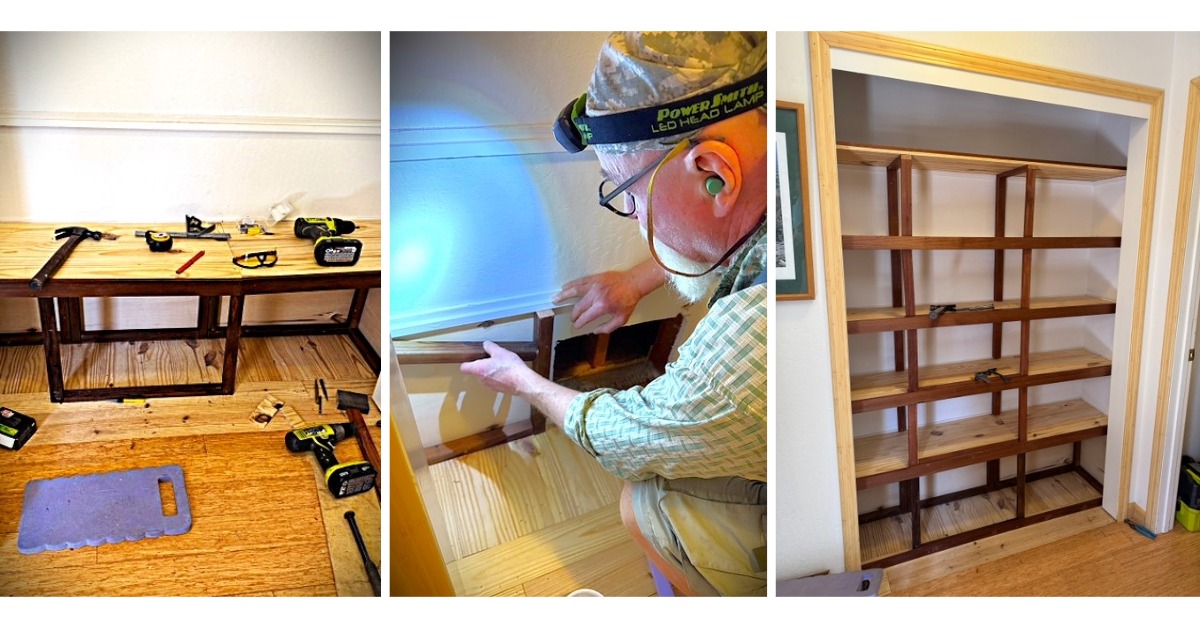
REBUILDING MY HALL CLOSET
While becoming a lifelong news junkie, I’ve also sought to be an ardent ecologist. It’s made me a recycler of nearly pathological bent. To me, “Use it up, wear it out, make it do,” isn’t just some motto for a cranky Yankee tightwad. It’s also the way the entire natural world operates. So, of course, I attempt to participate. It’s part of truly being here.

For example, when it finally came time to renovate our hall closet, I made use of some redwood boards I’d saved for twenty years. I also utilized strips of trim I’d yanked off a wall four years back, even used nails and screws in good shape that I’d harvested from other projects. These went into boxes and jars until my current chance to redeploy ‘em.
I also blew the dust off my ancient carpentry skills—and tools from that era too—and escorted them back to life. Which I do every few years or so, minimum.
Our old hall closet was in pretty sad shape, and had annoyed me ever since we bought our house. Its shelves were lousy swaths of painted particle board that sagged under any load, even items as light as sheets and towels. So, heigh-ho, off-to-work-we-go!
Kindly try to reckon how much movement and thought were invested in my remedy for that closet, as related in a brief account below.
A TANGO & TANGLE WITH THE TOOLS

First, I stripped paint off the old trim using a Bosch hand planer. This gizmo has a rotating drum with a razor-sharp blade attached. I secured each piece to a sawhorse with a cam strap and slid the tool up and down all four sides of the piece. It’s easy to gouge soft wood, so a light touch and a smooth, steady rhythm is essential. Also, you’re shaving multiple pieces, and you want them to end up with a similar thickness. That requires careful attention to depth setting and the number of passes you make. The fewer passes needed to get such a job done, the better you are at it.
Pro tip: glide gently in and out of each pass to avoid nicking the material. The planer should always hum, never growl or shriek. (Actually, this is a fine tip for plenty of other activities!)
For those wider, would-be structural redwood pieces, I got into a stack of redwood boards with a storied past. I’d been out buying second-growth, rough-cut boards for a perimeter fence when the recycled wood merchant told me he could also offer me a cool deal on clear vertical grain boards once used to make giant fermentation tanks for Sebastiani Winery. I jumped on it, scoring dozens of planks milled a foot wide by both full inch and ½-inch thicknesses and stored them all in my garage. They had a faintly purple hue and emitted a rather pleasant scent.

For the hall closet project, I selected the 1/2-inch items and sliced them into 4-inch wide boards on a table saw.
You can lose a patch of skin if you handle a planer badly, but with a table saw, fingers and your entire hand are at risk. One must pay extremely pointed attention each second that machine is switched on. Also, wear a dust mask, goggles and ear plugs. You don’t need to protect every single part of your body when using a table saw; only those items you hope to retain.

Through my dust mask I could smell the rich, floral residue of the tons of fermenting grape juice once-upon-a-time cured in those wine tank boards. The spicy aroma of the knotty pine I’d selected for the closet shelves seeped through, as well. This pine also had a story behind it. I’d gone to several building supplies, seeking unpainted 1”x12” pine, but those formerly common boards were nowhere to be found. I suspect USA tariffs on Canadian wood products ought to be blamed. I did find primed and painted 1”x12”, but since the coat of paint concealed the inner quality of this material, I turned it down.
Besides, for these closet shelves, I’d visualized exposing the natural beauty of exposed wood grain. So, I opted for packages of ½ inch knotty pine interior siding, which would award me a desired look, but would require v-e-r-y precise design and handling to end up with the requisite shelf strength.

The natural slickness of resinous pine also meant no finish would be needed for that material, but I did need to apply something special to the redwood. Luckily, I still owned a few cans of Good Stuff—a protective finish made of synthetic oils from the Bally Block & Michigan Maple Block companies. My large can was spoiled and hard; too much air had trickled in. But the tiny quarter-pint item held enough active gel to pull off this chore. I wiped it onto the redwood with strokes of a soft rag. The key here was doing it under mild evening sunshine so I could perceive an even coating throughout the procedure.
Another key was doing it outdoors as a light breeze blew around me, and nitrile gloves protected my hands. The can’s warning labels suggested that breathing its fumes or enduring prolonged contact on my bare skin could coax me to call it the Not-So-Good-Stuff.
BUILD A RUBIK’S CUBE YOU CAN USE
Materials prepared, it was now time to attack the assembly. Its overall design was nothing I could sketch, map out or blueprint ahead of time, since it all depended on how well I could jigger thin, ½-inch material into a sturdy set-up. This meant experimenting with varied configurations, ripping out what didn’t work, trimming off the ruined bits and starting over.

I graduated from this creative “cussed” phase with my plan: a double support cradle in the middle of each shelf’s five-foot span, with the load distributed onto vertical support staves. As I built, the thin material had to be coddled so that it wouldn’t split; which meant drilling pilot holes for each nail, while using as few nails as possible. The nails I did use were mainly placed to jam pieces of wood against each other in a manner that halted movement. Overall, this process resembled trying to glue together a house of cards at its key seams…
My nails were a scanty lot: a half-box of four-penny (4d) box nails with a light galvanization, and a third-full box of bright three-penny (3d) finish nails. The 4d fasteners sported a tighter grip on the shaft and a patterned head, which made ‘em easiest to deploy in tight spots. The 3d items were bastards, not quite sharp enough, with a crappy dimple that wouldn’t accept the tip of a nail-set tool. (Seems to me, we made MUCH better finish nails 50 years ago; another signal of the near collapse of human civilization…)

Anyway, the upshot was, at the end of the day (several days, actually), our wee family had gained a closet that wouldn’t embarrass us if we happened to slide its door open in front of guests. That refurbished receptacle might not hold water, but it certainly could hold linens—and without showing any sags!
Plus, I was thrilled that my guesstimates on materials had panned out: I had exactly seven 3d nails left at the end of this job, only twice that many 4ds, zero redwood boards except for a few stray bits, and a couple of full pine boards to save and then deploy another time on some other project.

My other harvest was personal and interior: a body stretched through an astonishing array of informal yoga positions while I’d fought for physical vantage points inside a tight closet space. As well as that tiredness that only derives from full days of physical labor. That always induces a sweet and deep sleep.
And such rest can also be bolstered by your degree of satisfaction in a job well-done.